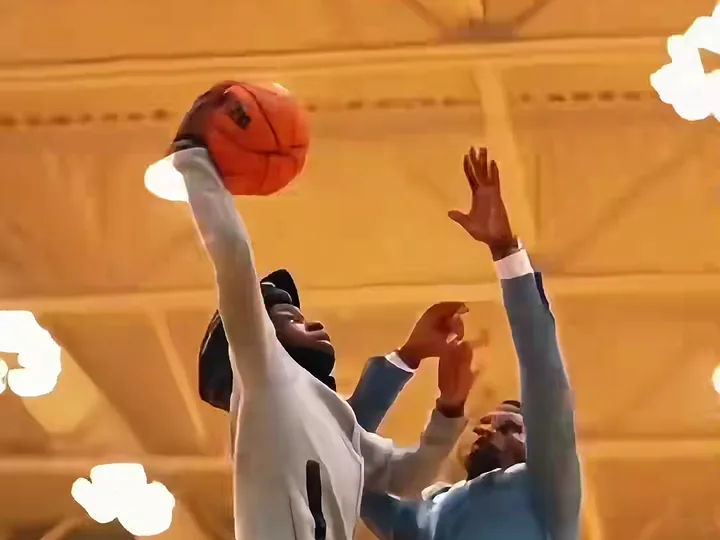
For what the prompt is and what it must solve, see the main basketball dunk AI prompt page; this post covers only why copied prompts fail. A basketball dunk AI prompt works because it is not one sentence but a small script: it pins down who the dunker is, who the defender is, what the gym looks like, what the camera does in each second of a 6-second clip, and what must never appear. Copied prompts fail because they were written for a different photo, a different model and a different tool, and the video model fills every gap with a guess. Basketball Dunk AI builds that script into three templates, so you upload a photo and the part that usually breaks is already handled.
Key takeaways
- A good dunk prompt is a layered brief: identity, opponent, set, six timed beats, camera moves and a list of things to keep out of frame. A copied one usually keeps the wording and loses the reason behind it.
- The five classic failures are a face that drifts in the leap, a defender who borrows your face, logos and jerseys that leak in, beats that land at the wrong second, and a ball that never reaches the rim.
- Most of these failures are decided by the photo and the model, not by the wording, so editing words rarely cures them.
- Basketball Dunk AI is built so you do not write a prompt: Standard at 720p costs 10 credits, and a render that fails or is blocked returns its credits.
- This is an independent tool. It is not affiliated with the NBA, any league or team, TikTok or CapCut, and its gyms are generic.
If you only want to see the result, open the generator and pick a template. If you want to know why the shortcut exists, read on. The short, practical version of the same topic lives on the basketball dunk ai prompt page, and the plain steps are on how to make a basketball dunk ai video.
What is a basketball dunk AI prompt actually doing?
A basketball dunk AI prompt is a written brief that tells an image-to-video model how to turn one still photo into a short highlight. It does not describe a dunk in general. It describes one specific 6-second clip, and each part of it carries a different job.
The trend that started on TikTok in mid-October 2026 produced clips of roughly 5.5 to 6 seconds. That length matters because a video model spends a fixed budget of attention across the whole clip. Whatever the brief does not pin down, the model invents. So a working brief tends to cover five layers.
Identity. Which person in the photo is the dunker, and what must stay the same about them: face, hair, outfit, skin tone, build. This layer fights drift.
Opponent. Who defends, how they look, and how they differ from the dunker. This layer fights cloning.
Set. A plain gym, a hoop, a floor, lights. This layer decides what the background is allowed to contain.
Timeline. What happens in each stretch of the six seconds. This layer fights vague, floaty motion.
Exclusions. What must not show up: readable text, brand marks, team kits. This layer fights leakage.
What this section proved: a dunk prompt is a layered brief for one 6-second clip. What it left unsolved: why the same brief still breaks in predictable places, which the next five sections cover.
Why does my face drift during the leap?
Faces drift in a basketball dunk AI clip because the leap is the hardest second for the model. The body moves fast, the camera tilts up, the head turns, and the model has to rebuild your face in every frame from a single reference photo.
Think of the photo as the only evidence the model has about you. If it is small, dark, filtered or taken from the side, the evidence is thin. During the drive the face is large and steady, so thin evidence still looks acceptable. During take-off, in the stretch from about 1.0 to 1.6 seconds, the head is small, moving and partly turned, so the model leans on its own idea of a generic athlete. The face you get at the rim is a blend of you and that idea.
A prompt can ask the model to keep your face, but it cannot add pixels the photo never had. This is the first place a copied prompt disappoints: the wording says "keep the face the same", the model tries, and the result still slides toward a stranger because the reference was weak. A fix by editing words is a fix aimed at the wrong layer.
What moves the result is on the other side of the screen: a sharp, front-facing, evenly lit photo with the full body visible, a higher model tier (Pro and Ultra hold faces better than Standard), and a second render, since video models vary from run to run. Even then, the ball or a hand can smear for a frame in the leap.
- The photo. Sharp, front-facing, evenly lit and with the full body visible gives the model the most to hold onto.
- The model tier. Pro and Ultra hold faces better than Standard, which is why they exist as options.
- A second render. Video models vary from run to run, so a second take of the same photo is normal.
What this section proved: face drift is mostly an evidence problem. What it left unsolved: what happens when a second face enters the scene.
Why does the defender clone my face?
The defender clones your face because the model reuses the strongest identity signal it has. In a one-photo dunk, your face is the only face in the input, so when the brief says "a defender jumps with both arms up", the model has no second face to use and quietly borrows yours.
This is the most surprising failure for people who copy a prompt, because the text clearly says the defender is someone else. The sentence is there, and yet the clip shows two versions of you, one dunking and one getting dunked on. The model treats a repeated face as a cheap way to stay consistent across frames, so it takes the shortcut unless the brief and the setup both push against it.
The setup decides how much room cloning has. In Poster Dunk the defender is invented, so one photo is enough, and a lookalike can still appear on a given run; a second render usually settles it. In Dunk on Your Friend the defender comes from a second photo, so each face has its own reference. Use a friend's photo only with their permission.
- In Poster Dunk, the defender is invented, so only one photo is needed. The brief keeps the defender a different person, but a model can still produce a lookalike on a given run. A second render usually settles it.
- In Dunk on Your Friend, the defender is a real person from a second photo. Photo 1 is the dunker and Photo 2 is the defender, so each face has its own reference and cloning has much less room to happen.
- In Open Gym Slam, the defender and the players waiting on the baseline are invented, and the camera sits lower and closer.
What this section proved: one face in, two faces out is a model shortcut. What it left unsolved: the background and clothing, which carry their own risks.
How do logos and jerseys leak into a dunk clip?
Logos and jerseys leak into a dunk clip because the model has seen thousands of real basketball broadcasts, and it reaches for them whenever a brief says "basketball", "pro" or "highlight". A copied prompt that name-drops a league, a team, a famous arena or a star is asking for exactly that leak.
Leakage shows up in three ways. A jersey picks up a team look, a floor grows a logo at center court, or the scoreboard shows text that reads like a real broadcast. None of it is intentional, and all of it is a problem. It makes the clip look like an official league product when it is not, and many platforms and rights holders treat that as misleading. It also puts a real organisation's marks in a video you may post publicly.
Basketball Dunk AI handles this on the set layer. Its gyms are generic: a school gym, a recreation center and a pickup-run open gym, with no league logos, no team jerseys and no famous players. The exclusions layer tells the model to keep readable text and brand marks out of frame. The site is explicit that it is not affiliated with the NBA, any league or team, TikTok or CapCut.
What this section proved: leakage comes from association, so the cure is a generic set and a clear exclusion list. What it left unsolved: the clock, which is where timing goes wrong.
Why does beat timing go wrong in a copied prompt?
Beat timing goes wrong in a copied prompt because the prompt was written for a different clip length, and a video model reads time loosely unless the brief is anchored to it. A dunk is a sequence of fast moves, and a one-second error is the whole difference between a slam and a stumble.
The 6-second clip has a clear shape, and Basketball Dunk AI publishes it:
- 0.0 to 1.0 s, the drive. A low, wide shot of two hard dribbles toward one defender.
- 1.0 to 1.6 s, take-off. You gather the ball and leap, and the defender jumps with both arms up a beat too late.
- 1.6 to 2.8 s, the slam. The camera looks up from under the basket, you throw it down and hang on the rim.
- 2.8 to 4.2 s, the replay. A second angle from the baseline shows the same drive and leap from the side.
- 4.2 to 5.0 s, through the net. A close-up of the ball dropping through the rim.
- 5.0 to 6.0 s, the landing. You land, turn to the camera and celebrate.
A prompt copied from a 10-second or 15-second trend spends its seconds differently, so take-off lands late, the replay is cut and the model stretches or drops beats to fit. The timeline belongs to the template, which is why a tested 6-second setup gives the same shape on every run.
What this section proved: a prompt without the right clock produces a different, worse clip. What it left unsolved: the one thing every dunk clip needs, which is the rim.
Why does the ball miss the rim?
The ball misses the rim, or the dunk happens a hand-width away from the hoop, because a video model does not understand the physics of a dunk. It understands what a dunk usually looks like, and it paints that from memory.
Rim contact is a small, precise event in a large, busy frame. The hand has to meet the ball, the ball has to meet the rim and the body has to hang from it, all within a few frames. The model gets close to this for the slam and the through-the-net close-up when the brief names those moments clearly, because those beats are the most common in its training. It gets it wrong when the brief is vague about where the hoop is, when the camera angle hides the rim, or when a second player blocks the line. Wording helps little here. A motion reference that already contains a real dunk, a camera that starts under the basket and the finer detail of Pro and Ultra matter more. If the ball still floats or smears, render again; failed or blocked renders return their credits.
- The floating dunk. The hand and ball hover under or beside the rim.
- The disappearing ball. The ball smears for a frame during the leap and returns in the wrong place.
- The wrong net. The close-up of the net shows a different rim from the slam.
What this section proved: the rim is the hardest target in the clip. What it left unsolved: why trying to fix all of this by hand costs more than it looks.
Why is a copied prompt the wrong tool for the job?
A copied prompt is the wrong tool because it fixes the problem in the wrong place. All five failures above are decided by inputs that a pasted sentence cannot change, and chasing them through trial and error is slow and expensive.
Look at where each failure really lives:
| Failure | Where it is decided |
|---|---|
| Face drift in the leap | The photo and the model tier |
| Defender cloning your face | The number of photos and the template |
| Logos and jerseys leaking | The set and the exclusion list |
| Wrong beat timing | The clip length and the timeline |
| Missing the rim | The motion reference, camera and model |
What this section proved: the cure for these failures is a tested setup, not more words. What it left unsolved: what the shortcut looks like in practice.
What does Basketball Dunk AI do instead of asking for a prompt?
Basketball Dunk AI replaces the prompt box with a template, a photo and a model choice. The brief, the motion reference and the six beats are already built in and tested, so the only decisions left are the ones that really change the result.
Here is what you choose:
- Template. Poster Dunk takes one photo and gives you a one-hand dunk over an invented defender, hanging on the rim. Dunk on Your Friend takes two photos and puts a real friend on the receiving end. Open Gym Slam takes one photo and gives you a pickup-run, two-hand slam.
- Model. Standard (Seedance 2.0 Mini) is the default. Fast, Pro and Ultra use Seedance 2.0 and 2.5 by ByteDance, and the higher tiers hold faces and hands better.
- Resolution and ratio. 480p and 720p on every model, 1080p on Pro and Ultra, in 9:16, 1:1 or 16:9.
The credit costs are listed in the table below, so you can match the cost to the shot:
| Model | 480p | 720p | 1080p |
|---|---|---|---|
| Standard | 5 | 10 | not offered |
| Fast | 8 | 17 | not offered |
| Pro | 10 | 20 | 50 |
| Ultra | 17 | 37 | 93 |
The result is a 6-second MP4 with the trend sound already mixed in and no watermark. Standard takes about four minutes. Credit packs are one-off, never expire and are not refundable, and there is no free tier. The pricing page lists every pack by name, starting with the Single pack, which covers one Standard 720p video.
Adults only, and only your own photo or one you have permission to use. When you are ready, open the generator.
What this section proved: the shortcut works by moving every decision that matters into a tested template. What it left unsolved: nothing the next question cannot answer.
Frequently asked questions
Can I use a different prompt in Basketball Dunk AI?
No. Basketball Dunk AI does not have a prompt box, because the basketball dunk ai brief, motion reference and six beats are built into each template. You choose a template, a photo and a model tier. This keeps timing, set and exclusions consistent, and it means no wording can break the clip before it renders.
Why do two basketball dunk ai clips from the same photo look different?
Video models vary from run to run, so two renders of one photo in Basketball Dunk AI can differ in face detail, the defender or a blurred hand. That is normal for any basketball dunk ai video. Render again, or use Pro or Ultra for steadier faces. A failed or blocked render returns its credits automatically.
Does the basketball dunk ai prompt decide how long the clip is?
The 6-second length is a property of the template, not of the wording. Basketball Dunk AI renders every basketball dunk ai clip at 6 seconds, which matches the viral template clips of about 5.5 to 6 seconds. The six beats, from the drive to the landing, are timed to fit that length exactly.
Can a prompt remove a team logo from my dunk video?
Not reliably, which is why Basketball Dunk AI uses generic gyms instead. A basketball dunk ai clip built on a school gym, recreation center or open gym has no league logos or team jerseys to remove. Your own clothes are copied from the photo, so wear plain ones if you do not want a brand on screen.